
Pay rise in % and £
Salary Increase Calculator UK: What Is My Pay Rise Worth?
Loading calculator…
✓ Rates checked against HMRC for 2026/27. Free to use. Nothing you type leaves your device.
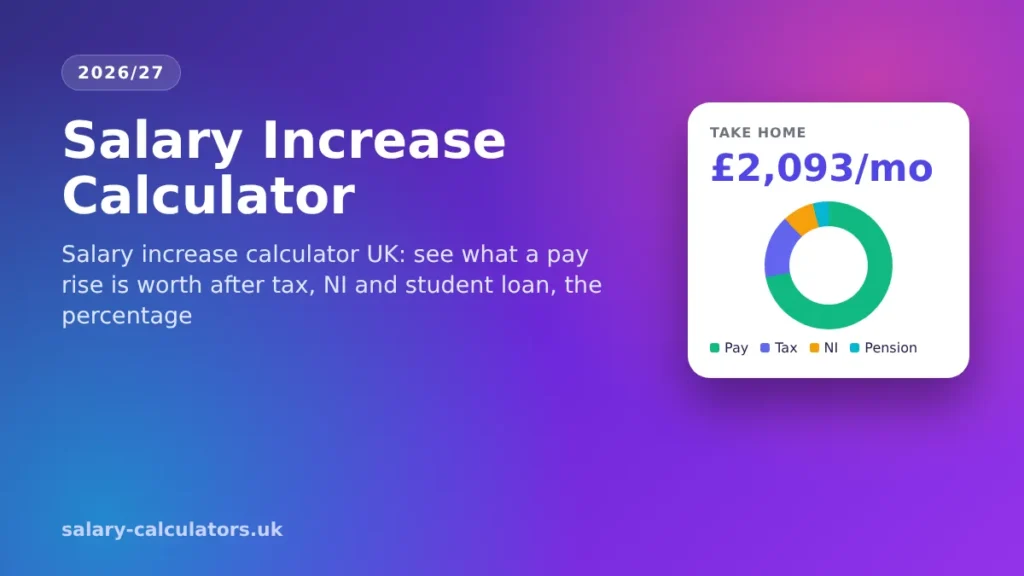
Use this salary increase calculator to see a pay rise as a percentage and in pounds, and how much more you actually take home each month after tax and National Insurance.
Quick answer: A 5% rise on £35,000 adds £1,750 a year gross, but about £1,260 a year (£105.00 a month) to your take home in 2026/27. You keep 72% of the rise.
How to calculate a percentage pay rise
- New salary = old salary × (1 + rise % ÷ 100)
- Rise % = (new salary minus old salary) ÷ old salary × 100
- Example: £35,000 to £36,750 is a 5% rise
How much of a pay rise you keep
| Your salary is in | You keep from each extra £1 (England) |
|---|---|
| Basic rate (£12,571 to £50,270) | 72p (20% tax, 8% NI) |
| Higher rate (£50,271 to £100,000) | 58p (40% tax, 2% NI) |
| £100,001 to £125,140 | 38p (60% effective tax, 2% NI) |
| Additional rate (over £125,140) | 53p (45% tax, 2% NI) |
A student loan takes another 9p in every pound above your threshold, so a Plan 2 graduate on £40,000 keeps about 63p of each extra pound.
Pay rise vs inflation
A rise only makes you better off if it beats prices. Use the salary inflation calculator to compare your old salary in today’s money.
“A pay rise is taxed at your top rate. In the basic rate band you keep about 72p of every extra £1.”
Share on X“Between £100,000 and £125,140 you keep only about 38p of each extra pound.”
Share on X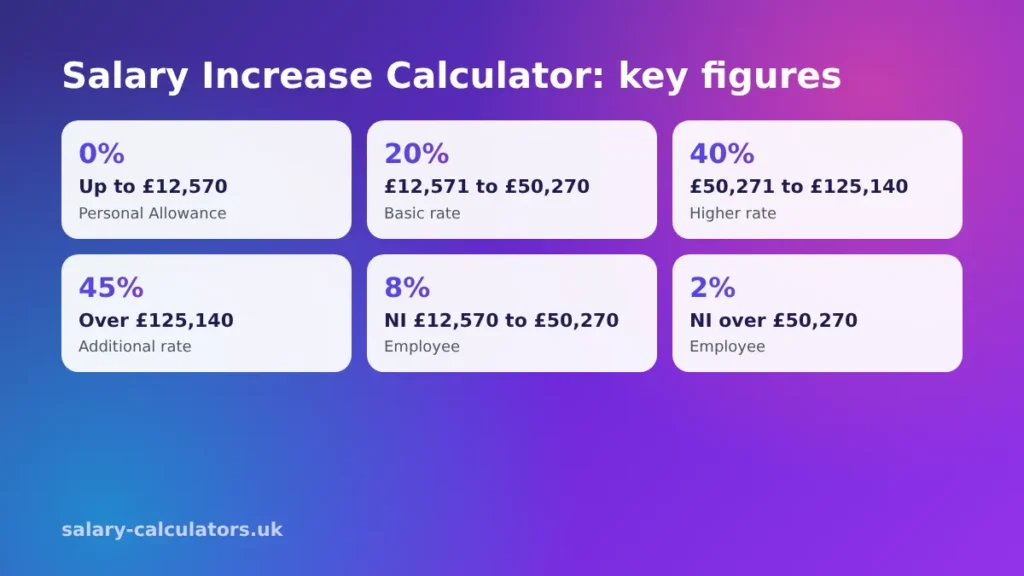
Worked example: £48,000 to £52,000
| Step | Amount |
|---|---|
| Rise | £4,000 (8.3%) |
| Extra income tax | £1,146.00 |
| Extra National Insurance | £216.20 |
| Extra take home a year | £2,637.80 |
| Share of rise kept | 66% |
Part of this rise crosses £50,270, so the top slice is taxed at 40% and you keep a smaller share.
Who this calculator is for
- Anyone negotiating or reviewing a pay rise.
- People crossing the £50,270 or £100,000 thresholds.
- Managers explaining rises to staff.
Pay rise questions answered
How do I calculate a percent increase in salary?
Salary increase percentage = (new salary minus old salary) ÷ old salary × 100. The formula works in Excel too: =(B1-A1)/A1. A pay hike from £30,000 to £33,000 is a 10% increment.
| Rise | On £30,000 | Extra take home per month |
|---|---|---|
| 2% | £30,600 | £36.00 |
| 3% | £30,900 | £54.00 |
| 4% | £31,200 | £72.00 |
| 5% | £31,500 | £90.00 |
| 6% | £31,800 | £108.00 |
| 7% | £32,100 | £126.00 |
| 10% | £33,000 | £180.00 |
| 15% | £34,500 | £270.00 |
Annual or mid year pay rise
Annual pay rises are often applied in April or on your work anniversary. A mid year rise only affects pay from that date, so this tax year’s total gross is a mix of the old and new salary.
Backdated (retro) pay rises
A backdated or retroactive pay rise is paid as a lump sum for the months already worked. It is taxed in the month it is paid, like a bonus, which can make that payslip look heavily taxed.
Hourly and monthly pay rises
For hourly workers, a rise from £12.21 to £12.71 an hour is 4.1%. Monthly pay rises scale the same way. Use the hourly pay calculator to convert.
Pay rise vs inflation (CPI)
Real pay growth is your pay increase minus inflation. If CPI is higher than your rise, your real pay has fallen. Check it with the real terms pay calculator.
Can a pay rise reduce my take home?
No. A pay rise never leaves you with less take home overall, although at certain levels (over £100,000, or the High Income Child Benefit Charge from £60,000) you keep a much smaller share. A pay decrease works the same way in reverse.
Pay rise in Scotland
In Scotland the 21% intermediate and 42% higher bands start lower, so a rise between £29,527 and £75,000 keeps a little less than in England. Choose Scotland in the calculator.
Next year’s pay rise and budget planning
Planning a budget for next year? Enter your expected new salary to see your future monthly take home.
How to calculate what a pay rise is worth
- Note your current yearly salary.
- Work out the new salary: current × (1 + rise %).
- Calculate take home on both salaries.
- The difference is the real value of your rise.
The calculation shows the yearly and monthly change in take home. If the rise is prorated because you joined part way through the year, only the months after the rise date use the new salary.
More questions answered
Should I accept a pay rise or a bonus?
A pay rise is permanent and compounds every year; a bonus is one off. A 5% rise is worth far more over several years than a one off 5% bonus.
How much pay rise should I ask for?
Many people use inflation plus a little more as a starting point, and research the market rate for their role. Check what the rise is worth after tax first.
Does a pay rise affect my pension?
Yes, pension contributions are usually a percentage of salary, so they rise too. That is extra saving, not lost pay.
Related calculators
- UK salary calculatorTake home pay after tax
- Bonus taxWhat you keep from a bonus
- Salary inflationReal terms value
- Net to grossSalary for a target take home
- Salary sacrificePension savings
- Average salaryCompare with the UK
Conclusion
This salary increase calculator shows exactly what your pay rise adds to your take home pay with 2026/27 rates.
Frequently asked questions
Should I ask for a percentage or an amount?
Either; the calculator shows both and what you keep.
Does a pay rise affect my student loan?
Yes, repayments are 9% of pay above your threshold.
How do I calculate a percentage pay rise?
Divide the increase by your old salary and multiply by 100.
How much of a pay rise do I keep?
About 72% in the basic rate band, 58% in the higher rate band, before pension and student loan.
Does a pay rise put me in a higher tax bracket?
Only the part above the threshold is taxed at the higher rate.

I am ACCA part qualified (11 of 13 exams passed) with an MSc in Accounting, and I work in UK accounts on reconciliations, VAT returns and reporting. I build and check every calculator here against the official HMRC rates. LinkedIn