
Updated for the 2026/27 tax year
UK Salary Calculator: Take Home Pay After Tax 2026/27
Loading calculator…
✓ Rates checked against HMRC for 2026/27. Free to use. Nothing you type leaves your device.
Enter your salary above to see your take home pay after income tax, National Insurance, pension and student loan for the 2026/27 tax year (6 April 2026 to 5 April 2027). This salary calculator works for England, Wales, Northern Ireland and Scotland and shows your pay by year, month, week, day and hour.
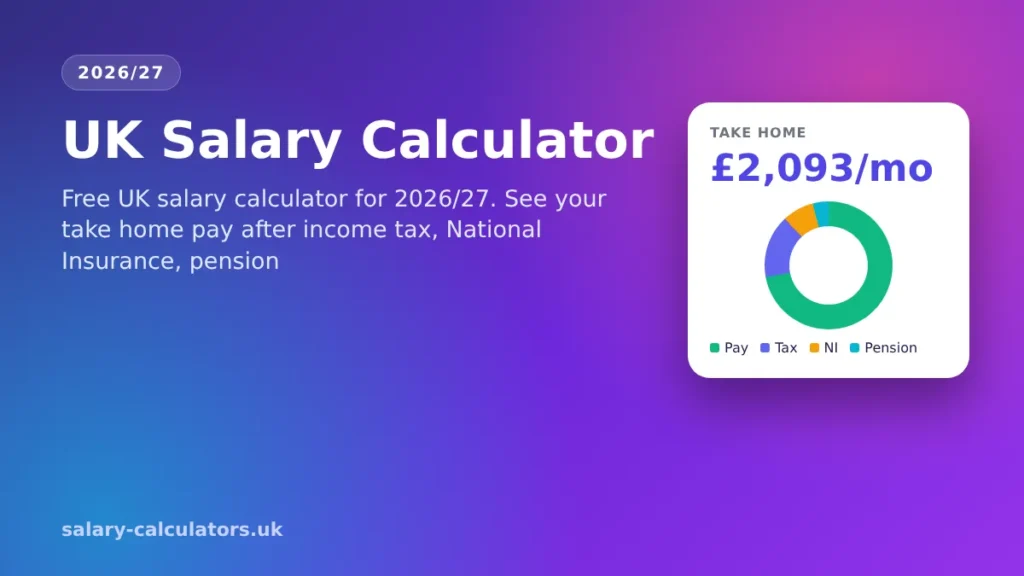
Quick answer: On a £30,000 salary in England, Wales or Northern Ireland you take home about £25,120 a year, or £2,093.30 a month, after £3,486 income tax and £1,394 National Insurance in 2026/27. Change any number in the calculator to see your own figures.
How to use the salary calculator
- Type your pay and choose how it is paid: per year, month, 4 weeks, 2 weeks, week, day or hour.
- Pick the tax year and where you live. Scotland has its own income tax bands.
- Open “Pension, student loan, tax code and more” to add your pension, student loan plan, tax code, bonus or overtime.
- Your take home pay updates instantly, with a full breakdown, a chart and your marginal tax rate.
Salary calculator results explained
The result shows your take home pay first, because that is the number most people need. Under it you can see every deduction by year, month and week:
| Line | What it means |
|---|---|
| Gross pay | Your pay before anything is taken off, including bonus and overtime |
| Tax free allowance | How much you can earn before income tax starts (usually £12,570) |
| Income tax | Tax charged on pay above your allowance, band by band |
| National Insurance | 8% on pay between £12,570 and £50,270, then 2% |
| Pension | Your own contribution, shown the way your scheme takes it |
| Student loan | 9% of pay above your plan threshold (6% for a Postgraduate loan) |
| Take home pay | What reaches your bank account |
You also get three useful extras: your marginal rate (how much of your next £100 goes in tax and deductions), your effective rate (the share of your whole salary taken off) and your employer’s National Insurance, which your employer pays on top of your salary and which does not reduce your pay.
Income tax rates 2026/27 in England, Wales and Northern Ireland
| Band | Taxable income | Rate |
|---|---|---|
| Personal Allowance | Up to £12,570 | 0% |
| Basic rate | £12,571 to £50,270 | 20% |
| Higher rate | £50,271 to £125,140 | 40% |
| Additional rate | Over £125,140 | 45% |
Income tax works in slices. Only the part of your pay inside each band is taxed at that band’s rate, so moving into the higher rate band never makes your whole salary taxed at 40%. The bands are frozen for 2026/27, which means the same figures as last year. Source: HMRC rates and thresholds for 2026 to 2027.
Scottish income tax rates 2026/27
If your main home is in Scotland, you pay Scottish income tax on your earnings. National Insurance is the same as the rest of the UK. Use the Scottish salary calculator for a Scotland only breakdown.
| Band | Earnings | Rate |
|---|---|---|
| Personal Allowance | Up to £12,570 | 0% |
| Starter | £12,571 to £16,537 | 19% |
| Basic | £16,538 to £29,526 | 20% |
| Intermediate | £29,527 to £43,662 | 21% |
| Higher | £43,663 to £75,000 | 42% |
| Advanced | £75,001 to £125,140 | 45% |
| Top | Over £125,140 | 48% |
“Moving into the 40% band does not tax your whole salary at 40%. Only the pounds above £50,270 are taxed at the higher rate.”
Share on XYour Personal Allowance and the £100,000 tax trap
Most people can earn £12,570 a year before paying income tax. This is the Personal Allowance and it is why the most common tax code is 1257L. Once your adjusted net income goes over £100,000, the allowance falls by £1 for every £2 you earn above that, and it is gone completely at £125,140.
That taper creates an effective income tax rate of 60% on pay between £100,000 and £125,140 (62% once National Insurance is added). The calculator includes it automatically. Pension contributions reduce adjusted net income, which is why many people in this range pay more into their pension or use salary sacrifice.
National Insurance rates 2026/27
| Earnings | Employee rate | Employer rate |
|---|---|---|
| Up to £5,000 | 0% | 0% |
| £5,001 to £12,570 | 0% | 15% |
| £12,571 to £50,270 | 8% | 15% |
| Over £50,270 | 2% | 15% |
National Insurance is worked out on each pay period, while this calculator uses yearly figures, so your payslip can differ by a few pence a month. If you are over State Pension age you stop paying employee National Insurance; tick that option in the calculator.
Tax codes explained
Your tax code tells your employer how much tax free pay to give you. The calculator uses 1257L unless you type a different code, which you can find on your payslip, your P60 or in your HMRC online account.
| Code | Meaning |
|---|---|
| 1257L | Standard Personal Allowance of £12,570 |
| S1257L | Scottish taxpayer with the standard allowance |
| C1257L | Welsh taxpayer (same rates as England) |
| K codes (for example K475) | You owe tax on a benefit or debt; the number is added to your taxable pay |
| BR | All pay taxed at the basic rate, often a second job |
| D0 / D1 | All pay taxed at the higher or additional rate |
| 0T | No tax free allowance |
| NT | No tax taken |
Student loan repayments 2026/27
| Plan | Who usually has it | Repayment threshold | Rate |
|---|---|---|---|
| Plan 1 | England or Wales before September 2012, or Northern Ireland | £26,900 | 9% |
| Plan 2 | England or Wales, September 2012 to July 2023 | £29,385 | 9% |
| Plan 4 | Scotland | £33,795 | 9% |
| Plan 5 | England, courses from August 2023 | £25,000 | 9% |
| Postgraduate loan | Master’s or doctoral loan | £21,000 | 6% |
Repayments are taken through payroll on pay above the threshold. If you have a Postgraduate loan as well as an undergraduate plan, both are taken. Try the student loan repayment calculator for your monthly figure.
Pensions and salary sacrifice
How your pension is taken changes your take home pay, even when the same amount goes into your pot.
| Pension type | Saves income tax? | Saves National Insurance? | How it works |
|---|---|---|---|
| Net pay arrangement | Yes | No | Taken from pay before tax |
| Relief at source | Yes (20% added by provider) | No | Taken after tax; higher rate relief claimed through Self Assessment |
| Salary sacrifice | Yes | Yes | You give up salary and your employer pays it into your pension |
Most workplace pensions use auto enrolment, where contributions are worked out on “qualifying earnings” between £6,240 and £50,270. Tick that option in the calculator if your payslip shows it. See the salary sacrifice calculator to compare all three side by side.
Bonus, overtime and taxable benefits
Bonuses and overtime are taxed as normal pay. They can push part of your income into a higher band in the month you are paid, which is why a bonus month often looks heavily taxed. Over the full tax year it evens out. Use the bonus tax calculator to see how much of a bonus you keep. Benefits in kind such as a company car or private medical insurance are taxed but do not attract employee National Insurance.
Take home pay for popular salaries 2026/27
| Salary | Income tax | National Insurance | Take home (year) | Take home (month) |
|---|---|---|---|---|
| £20,000 | £1,486 | £594 | £17,920 | £1,493.30 |
| £25,000 | £2,486 | £994 | £21,520 | £1,793.30 |
| £30,000 | £3,486 | £1,394 | £25,120 | £2,093.30 |
| £35,000 | £4,486 | £1,794 | £28,720 | £2,393.30 |
| £40,000 | £5,486 | £2,194 | £32,320 | £2,693.30 |
| £45,000 | £6,486 | £2,594 | £35,920 | £2,993.30 |
| £50,000 | £7,486 | £2,994 | £39,520 | £3,293.30 |
| £60,000 | £11,432 | £3,211 | £45,357 | £3,779.78 |
| £70,000 | £15,432 | £3,411 | £51,157 | £4,263.12 |
| £80,000 | £19,432 | £3,611 | £56,957 | £4,746.45 |
| £100,000 | £27,432 | £4,011 | £68,557 | £5,713.12 |
| £125,000 | £42,432 | £4,511 | £78,057 | £6,504.78 |
Click a salary to see a full breakdown. Figures assume the standard tax code, no pension and no student loan.
What your salary costs your employer
Your employer pays 15% National Insurance on your pay above £5,000 a year, plus at least 3% pension on qualifying earnings if you are auto enrolled. On a £30,000 salary that is £3,750 in employer National Insurance. See the full figure with the employer cost calculator.
Why your payslip might not match
- Pay periods: National Insurance and student loans are worked out per pay period, not yearly.
- Tax code: a different code (K, BR or emergency) changes your tax.
- Pension type: net pay, relief at source and salary sacrifice give different results.
- Other deductions: union fees, season ticket loans, cycle to work or charity giving.
- Timing: a bonus, back pay or a tax refund in that month.
“Your take home pay is your salary minus income tax, National Insurance, pension and student loan. Everything else is a detail.”
Share on XMore UK salary calculators
- Salary to hourlyConvert between hourly rate and salary
- Monthly salaryAnnual, monthly, weekly and daily pay
- Pro rata salaryPart time and term time pay
- Net to grossSalary needed for a target take home
- Pay riseWhat a raise adds to your take home
- ContractorInside and outside IR35
- NHS payAgenda for Change bands 2026/27
- Teacher salaryPay scales from September 2026
“On a £30,000 salary you keep about 84% of your pay after income tax and National Insurance in 2026/27.”
Share on XHow this calculator works
Every rate comes from GOV.UK: HMRC rates and thresholds for 2026 to 2027 and the Scottish Government income tax bands. The calculator applies the Personal Allowance (with the £100,000 taper), the income tax bands for your nation, Class 1 National Insurance, your pension and your student loan, all on a yearly basis. It runs entirely in your browser, so nothing you type is sent or stored. Read the full method on how we calculate. It is a guide, not financial advice.
Salary calculation questions people ask
How do I calculate take home pay from my salary?
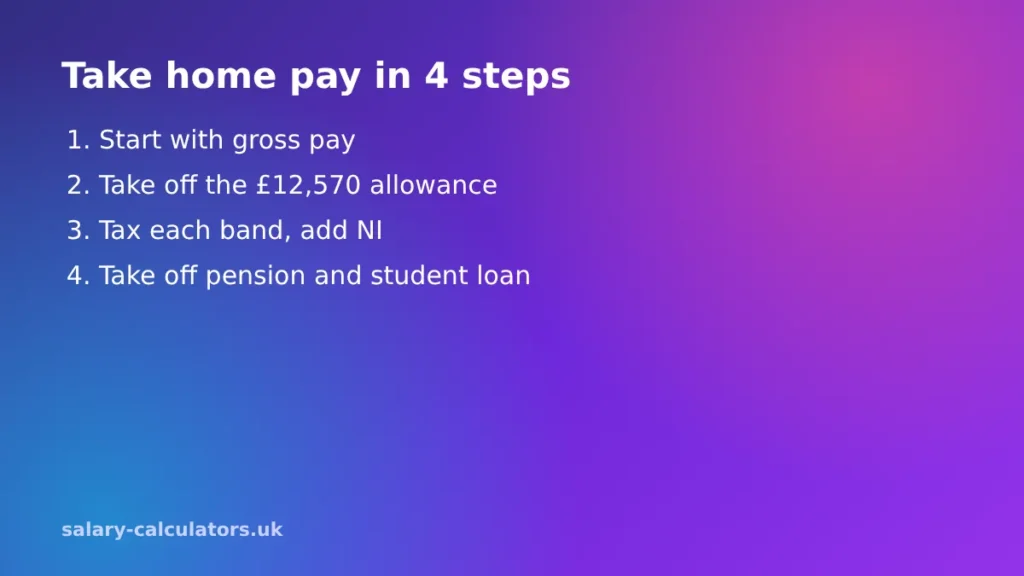
Calculating take home pay from a salary takes four steps: take off your tax free allowance, work out income tax band by band, add National Insurance, then deduct pension and student loan. Our full guide on how to calculate tax on your salary step by step shows every calculation with a worked example. The salary calculator above does the same salary calculations for you in one go.
What is my take home or bring home pay?
Take home pay, bring home pay, net pay and “nett” pay all mean the same thing: the money that actually lands in your bank account after deductions. Some people call it in hand pay. Gross pay is the figure before anything is taken off. The total deducted is the difference between the two.
Is this a United Kingdom wide calculator?
Yes. It covers the whole United Kingdom: England, Wales, Northern Ireland and Scotland. Whether you work in London, Manchester, Birmingham, Leeds, Liverpool, Bristol, Cardiff, Belfast, Edinburgh or Glasgow, income tax depends on where you live (Scotland or the rest of the UK), not the city. A British or English salary calculator gives the same answer as a UK one outside Scotland.
Income tax and NI on salary through PAYE
If you are employed and salaried, your employer runs Pay As You Earn (PAYE) and sends income tax and NI to HM Revenue and Customs (HMRC) for you. Your payslip (sometimes called a pay stub or pay slip) shows each payment deducted. Self employed people pay through Self Assessment instead; see the self employed tax calculator.
Two jobs or a second job
With two jobs your Personal Allowance usually goes against your main job, and your 2nd job is taxed with a BR code at 20%. Enter each job separately with its tax code (for example BR) to see the actual tax on each. National Insurance is worked out separately for each job.
Pre tax and post tax deductions
Pre tax deductions such as a net pay pension or salary sacrifice reduce your taxable pay. Post tax deductions such as a relief at source pension, union fees or a season ticket loan come out after tax. The calculator shows both so you can see the real, actual effect on what you take home.
What percentage of my salary is taxed?
The effective tax rate in your results shows the percentage of your whole salary that goes in deductions. The marginal rate shows the percentage of your next pound. A pay increase is taxed at your marginal rate, so use the pay rise calculator to see the difference a raise makes.
Do I need an app or a checker?
No download is needed. This simple, free salary checker works in any browser on phone or computer, uses the latest 2026/27 rates from GOV.UK (the govt website), and stores nothing. It is a quick way to check your payslip or compare a new job offer.
Salary breakdown by pay level
As pay rises, more of each pound goes in tax. The table below shows the breakdown at different levels and the share you keep.
| Salary | Take home | Kept | Marginal rate on next £1 |
|---|---|---|---|
| £15,000 | £14,320 | 95% | 28% |
| £25,000 | £21,520 | 86% | 28% |
| £40,000 | £32,320 | 81% | 28% |
| £55,000 | £42,457 | 77% | 42% |
| £90,000 | £62,757 | 70% | 42% |
| £110,000 | £72,357 | 66% | 62% |
| £150,000 | £91,286 | 61% | 47% |
Older payslips? Compare with the 2025/26 salary calculator for last tax year.
Take home pay: what is taken out and why
Taxes on a UK salary are not one charge but several. Income tax funds public services and is the largest deduction for most people. National Insurance builds your State Pension and access to some benefits. Pension contributions are your own savings, not a tax. Student loan repayments stop once the loan is repaid or written off.
When you are taking home less than expected, the best place to start is your payslip. Check the tax code, the pension line and any extra deductions. If the code is wrong, HMRC can correct it and refund overpaid tax through your pay. If you are working out what a new job is worth, use the calculator with both salaries and compare the monthly take home, not the gross.
Older tax years: 2021, 2022 and 2023
In 2021/22 and 2022/23 the bands were similar, but National Insurance was higher (12% and, for part of 2022/23, 13.25%). Take home pay on the same salary was therefore lower than today. Use the 2025/26 option for last year; for 2022 and earlier, HMRC’s historic rates apply.
Conclusion
This salary calculator gives you your UK take home pay for 2026/27 in seconds, with every deduction shown clearly and the official HMRC rates for England, Wales, Northern Ireland and Scotland. Change your salary, pension or student loan to see exactly how your pay changes, and use the related calculators when you need a specific answer.
Frequently asked questions
How do I calculate my salary after tax?
Enter your gross salary in the calculator. It takes off income tax, National Insurance, pension and student loan using 2026/27 HMRC rates.
Does the calculator work for London?
Yes. London uses the same income tax and NI as the rest of England.
How much tax will I pay on my salary?
Enter your salary in the calculator. In 2026/27 you pay 0% on the first £12,570, 20% up to £50,270, 40% up to £125,140 and 45% above that (different bands in Scotland).
How do I work out my take home pay?
Take your gross pay and subtract income tax, National Insurance, pension and any student loan. The calculator does this for you with the 2026/27 rates.
What is the Personal Allowance for 2026/27?
£12,570, the same as 2025/26. It reduces by £1 for every £2 of income over £100,000.
How much is National Insurance in 2026/27?
8% on earnings between £12,570 and £50,270 a year, and 2% above that.
Does the calculator work for Scotland?
Yes. Choose Scotland and the Scottish income tax bands are used. National Insurance is the same across the UK.
Is the salary calculator accurate?
It uses the official HMRC rates for 2026/27. Your payslip can differ slightly because payroll works per pay period and may include other deductions.
What tax code should I use?
Most people have 1257L. Use the code on your payslip or HMRC account if it is different.
Is my information stored?
No. The calculator runs in your browser and nothing you type is sent to us.

I am ACCA part qualified (11 of 13 exams passed) with an MSc in Accounting, and I work in UK accounts on reconciliations, VAT returns and reporting. I build and check every calculator here against the official HMRC rates. LinkedIn