Guide
How to Calculate Take Home Pay in the UK (2026/27)
Want to calculate tax on your salary yourself? Here is the exact method HMRC payroll uses, step by step, with a worked example for a £35,000 salary in 2026/27. If you just want the answer, use the UK salary calculator.
Loading calculator…
Quick answer: Take home pay = gross pay minus income tax minus National Insurance minus pension minus student loan. On £35,000 that is £35,000 minus £4,486 tax minus £1,794 NI = £28,720 a year, or £2,393.30 a month.
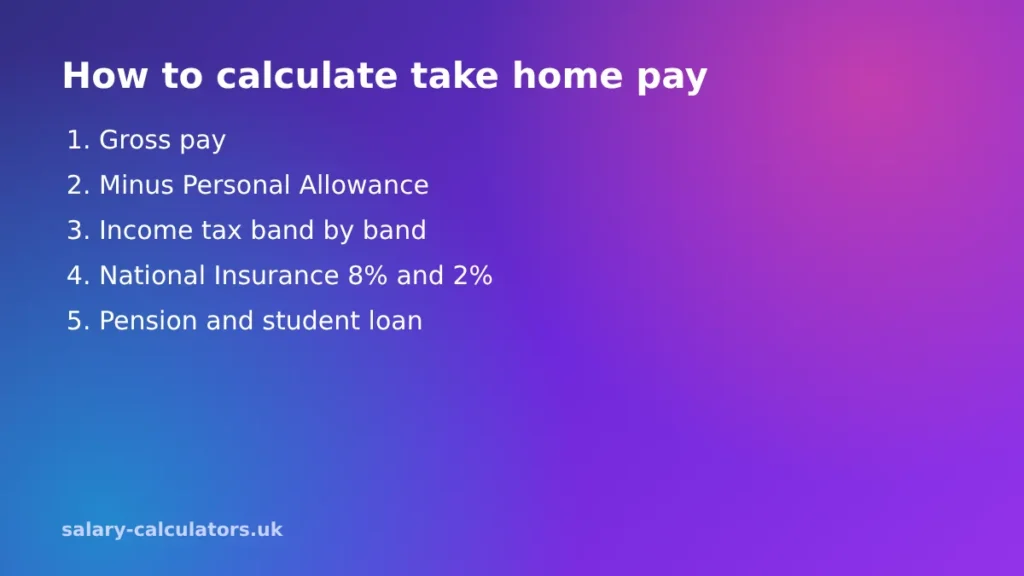
Step 1: start with gross pay
Gross pay is your salary plus bonus, overtime and any taxable allowances, before anything is taken off. If you have a salary sacrifice pension, take that off first.
Step 2: take off your Personal Allowance
Most people have £12,570 tax free (tax code 1257L). Taxable pay = £35,000 minus £12,570 = £22,430.
Step 3: work out income tax band by band
In England, Wales and Northern Ireland the first £37,700 of taxable pay is taxed at 20%. £22,430 × 20% = £4,486 income tax. Pay above £50,270 would be taxed at 40%, and above £125,140 at 45%. In Scotland use the six Scottish bands.
| Step | Calculation | Result |
|---|---|---|
| Gross pay | £35,000 | |
| Personal Allowance | £12,570 | |
| Taxable pay | £35,000 minus £12,570 | £22,430 |
| Income tax | £22,430 × 20% | £4,486 |
| National Insurance | (£35,000 minus £12,570) × 8% | £1,794.40 |
| Take home | £35,000 minus £4,486 minus £1,794.40 | £28,719.60 |
Step 4: work out National Insurance
Employees pay 8% on pay between £12,570 and £50,270 and 2% above. (£35,000 minus £12,570) × 8% = £1,794.40.
Step 5: take off pension and student loan
A 5% net pay pension on £35,000 is £1,750, which also reduces taxable pay. A Plan 2 student loan is 9% of pay above £29,385: (£35,000 minus £29,385) × 9% = £505.35.
Gross vs net pay
Gross pay is before deductions; net pay (take home) is what reaches your account. Employers quote gross salaries; your budget should use net.
“Take home = gross minus income tax minus National Insurance minus pension minus student loan.”
Share on X“Only the slice of pay inside each band is taxed at that band’s rate.”
Share on X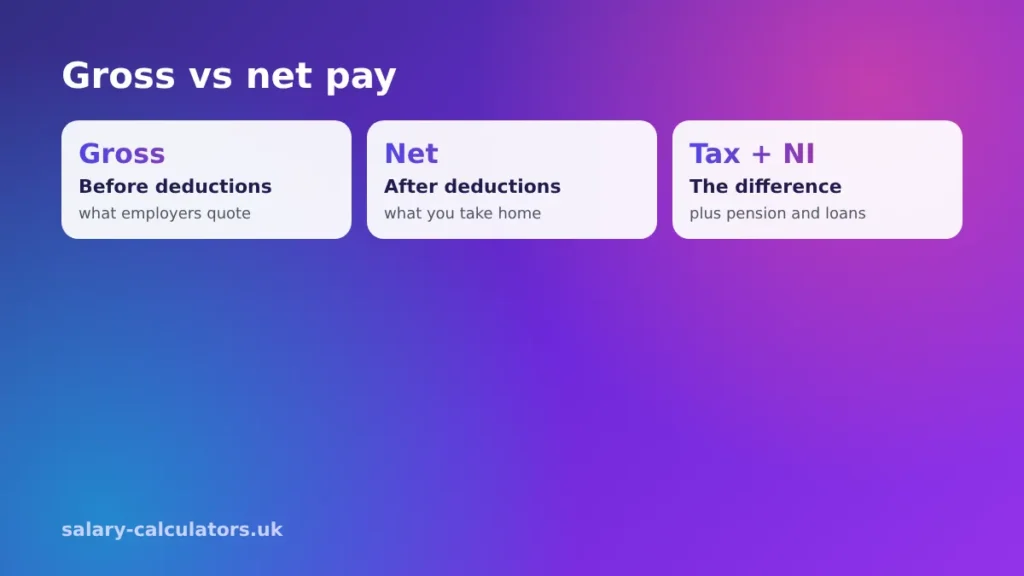
Calculating tax in Excel or a spreadsheet
You can build a simple salary sheet or template in Excel. Put gross pay in A1, then use:
- Taxable pay: =MAX(0,A1-12570)
- Basic rate tax: =MIN(MAX(0,A1-12570),37700)*0.2
- Higher rate tax: =MAX(0,MIN(A1,125140)-50270)*0.4 (ignores the £100,000 taper)
- Employee NI: =MAX(0,MIN(A1,50270)-12570)*0.08+MAX(0,A1-50270)*0.02
These formulas are fine for basic salaries under £100,000. Above that, or with pensions, student loans and Scottish bands, the calculator is more reliable.
How PAYE works on your payslip
Under PAYE (Pay As You Earn), your employer deducts tax each pay day using your tax code. Each month you get 1/12th of your allowance and 1/12th of each band, so tax is spread evenly. Your payslip shows gross pay, each deduction and net pay, with year to date totals.
Salary structure: basic pay and other pay
Your salary structure may include basic pay plus allowances, overtime, shift pay, bonus or commission. All of it is taxable income. Expenses your employer repays for business costs are not taxed if they are genuine business expenses.
Arrears, back pay and unpaid leave
Back pay (arrears) is taxed in the month it is paid. Unpaid leave reduces gross pay for that month, usually by 1/260th of salary per day, which also reduces the tax and NI for that month.
Tax for self employed and company owners
If you are self employed, tax is calculated on profit, not sales. Company directors may take salary and dividends; see the director salary and dividend calculator.
Other income and savings
Savings interest has its own allowance: £1,000 for basic rate and £500 for higher rate taxpayers, with a £5,000 starting rate for savings for people on low earnings. Dividends have a £500 allowance. These sit on top of your salary.
Minimum wage check
If your hourly pay (salary ÷ hours) is below the National Living Wage of £12.71 for those 21 and over, raise it with your employer or ACAS.
More questions answered
How is tax calculated on a monthly salary?
PAYE gives you 1/12th of your Personal Allowance and bands each month, so tax on a steady monthly salary is the yearly tax divided by 12.
How is tax calculated on overtime?
Overtime is added to that month’s pay and taxed at your normal rate.
What is a basic salary?
Your basic salary is your contracted pay before overtime, bonus or allowances.
Related calculators
- UK salary calculatorTake home pay after tax
- Net to grossSalary for a target take home
- Monthly salaryAnnual, monthly, weekly
- Salary to hourlyHourly rate both ways
- Student loanMonthly repayments
- Salary sacrificePension savings
Conclusion
To calculate tax on your salary, take off your allowance, tax each band, add National Insurance and then pension and student loan. Or let the salary calculator do it for you with the 2026/27 rates.
Frequently asked questions
How is tax calculated on salary in the UK?
Your Personal Allowance is taken off, then each slice of taxable pay is taxed at its band rate.
What is the difference between gross and net pay?
Gross is before deductions, net is take home after tax, NI, pension and student loan.
Is National Insurance worked out the same way as tax?
No, it uses its own thresholds: 8% from £12,570 to £50,270 and 2% above.

I am ACCA part qualified (11 of 13 exams passed) with an MSc in Accounting, and I work in UK accounts on reconciliations, VAT returns and reporting. I build and check every calculator here against the official HMRC rates. LinkedIn