
Bonus, overtime and commission
Bonus Tax Calculator UK: How Much of My Bonus Will I Keep?
Loading calculator…
✓ Rates checked against HMRC for 2026/27. Free to use. Nothing you type leaves your device.
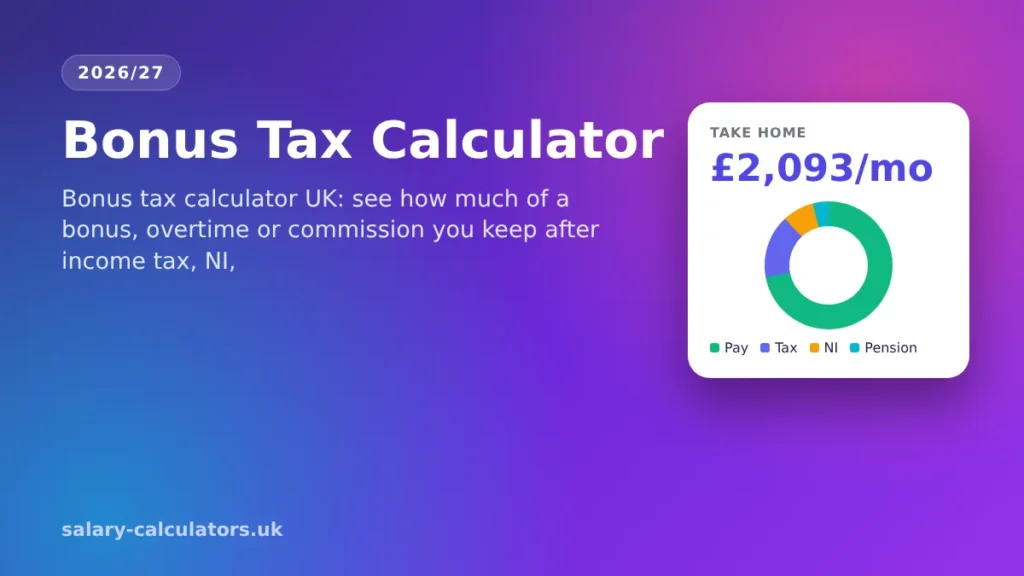
This bonus tax calculator shows how much of a bonus, overtime or commission payment you keep after income tax, National Insurance, pension and student loan.
Quick answer: On a £40,000 salary, a £5,000 bonus adds about £3,600 to your take home in 2026/27 (72%), because part of it falls in the 40% band.
How bonuses are taxed in the UK
There is no special bonus tax. A bonus is added to your pay and taxed through PAYE like salary, with income tax and National Insurance. In the month you are paid, payroll treats it as if you earn that much every month, which can make the deduction look high. Over the whole tax year it evens out.
| Salary | £5,000 bonus kept | £10,000 bonus kept |
|---|---|---|
| £30,000 | £3,600 | £7,200 |
| £40,000 | £3,600 | £7,200 |
| £50,000 | £2,938 | £5,838 |
| £60,000 | £2,900 | £5,800 |
| £90,000 | £2,900 | £5,800 |
| £100,000 | £1,900 | £3,800 |
Overtime and commission
Overtime and commission are taxed exactly like salary and bonus. Enter the yearly amount in the calculator to see the effect on your take home.
Can you pay a bonus into your pension?
Many employers offer bonus sacrifice, where the bonus goes straight into your pension before tax and National Insurance. It can be especially useful if the bonus would take you over £100,000. Use the salary sacrifice calculator to compare.
“There is no separate bonus tax in the UK. A bonus is taxed as normal pay through PAYE.”
Share on X“A bonus that takes you over £100,000 can face an effective 62% rate. Bonus sacrifice can help.”
Share on X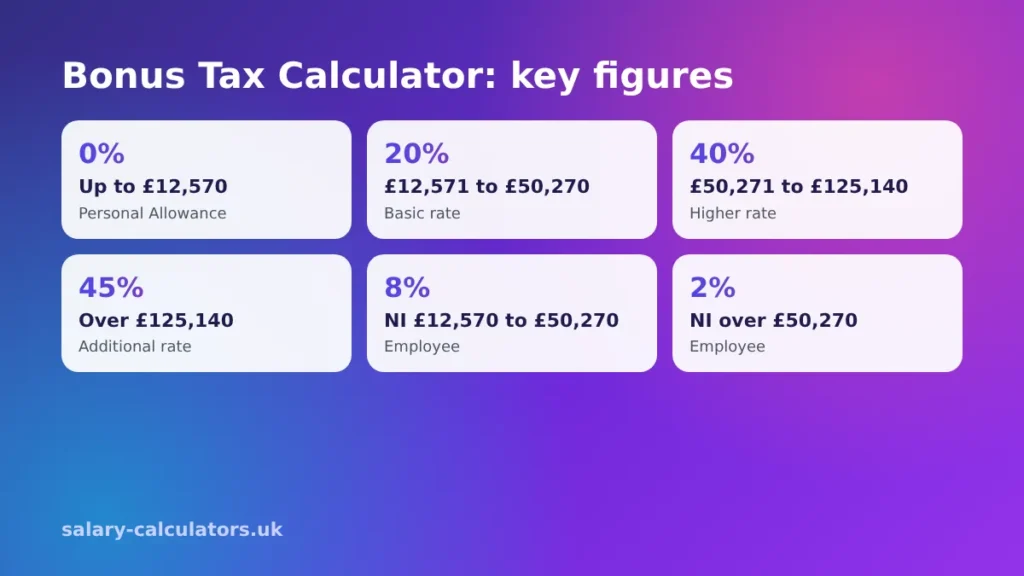
Worked example: £8,000 bonus on £55,000
| Step | Amount |
|---|---|
| Salary | £55,000 |
| Bonus | £8,000 |
| Extra income tax | £3,200.00 |
| Extra National Insurance | £160.00 |
| Bonus kept | £4,640.00 |
On £55,000 the whole bonus falls in the 40% band, so you keep 58% of it.
Who this calculator is for
- Employees expecting a bonus or commission.
- People paid regular overtime.
- Anyone thinking about bonus sacrifice into a pension.
Bonus questions answered
How is bonus tax calculated?
Your employer adds the bonus to your basic pay for that month and runs PAYE. The tax calculated is the extra tax caused by the bonus. Whether the bonus is one off, quarterly or annual, the calculation is the same: it is taxed as part of your salaried income.
| Bonus | On £30,000 | On £45,000 | On £60,000 |
|---|---|---|---|
| £1,000 | £720 | £720 | £580 |
| £2,500 | £1,800 | £1,800 | £1,450 |
| £5,000 | £3,600 | £3,600 | £2,900 |
| £7,500 | £5,400 | £5,088 | £4,350 |
| £10,000 | £7,200 | £6,538 | £5,800 |
| £15,000 | £10,800 | £9,438 | £8,700 |
Does my bonus include National Insurance?
Yes. Bonuses including commission and overtime pay National Insurance at 8% (or 2% above £50,270) as well as income tax.
Bonus based on a percentage of salary
If your bonus is based on a percentage of base salary, for example 10% of £40,000, enter £4,000 as the bonus.
Bonus in a 13th month
Some employers pay a 13th, 14th or even 7th or 8th payment as a bonus. In the UK these are taxed like any other bonus.
Can I reduce tax on my bonus?
Bonus sacrifice into your pension is the main legal way. Use the salary exchange calculator to compare.
How to calculate the tax on a bonus
- Work out your normal yearly take home.
- Add the bonus to your yearly gross and calculate take home again.
- The difference between the two is what you keep.
- Divide by the bonus to see the percentage kept.
This yearly method is the most accurate way to calculate bonus tax. Payroll calculates it per pay period, so the month of the bonus may show more or less tax, but it evens out over the year.
How much of a 5%, 10% or 15% bonus you keep
| Salary | 5% bonus kept | 10% bonus kept | 15% bonus kept |
|---|---|---|---|
| £30,000 | £1,080 | £2,160 | £3,240 |
| £40,000 | £1,440 | £2,880 | £4,320 |
| £50,000 | £1,488 | £2,938 | £4,388 |
| £70,000 | £2,030 | £4,060 | £6,090 |
| £90,000 | £2,610 | £5,220 | £7,130 |
Bonuses that push your income over £50,270 or £100,000 keep a smaller share. Taxes on a bonus are the same as taxes on salary.
More questions answered
When is a bonus paid?
Usually with normal pay in the bonus month. Some employers pay quarterly or yearly bonuses on separate dates.
Do bonuses count towards a mortgage?
Lenders often count part of a regular bonus, typically 50%, if you can show it has been paid for two years or more.
Is a bonus taxed in Scotland differently?
Yes, Scottish bands apply, so a bonus taking you over £43,663 is taxed at 42%.
Related calculators
- UK salary calculatorTake home pay after tax
- Pay rise calculatorWhat a raise is worth
- Salary sacrificePension savings
- Net to grossSalary for a target take home
- Monthly salaryAnnual, monthly, weekly
- Salary to hourlyHourly rate both ways
Conclusion
This bonus tax calculator shows the real value of any bonus, overtime or commission after 2026/27 tax and NI.
Frequently asked questions
Is a bonus taxed in the month it is paid?
Yes, through PAYE in that pay period.
Can I avoid tax on a bonus?
Paying it into your pension through bonus sacrifice can reduce tax and NI legally.
How much tax will I pay on my bonus?
The same rate as your top slice of pay: usually 20% or 40% income tax plus 8% or 2% NI.
Why was my bonus taxed so much?
PAYE treats the bonus month as if you earn that every month. It usually evens out over the year.
Is overtime taxed differently?
No, overtime is taxed as normal pay.

I am ACCA part qualified (11 of 13 exams passed) with an MSc in Accounting, and I work in UK accounts on reconciliations, VAT returns and reporting. I build and check every calculator here against the official HMRC rates. LinkedIn